How to Lower Your Electricity Bill: Tariffs, Timing and the Help You Can Claim
Most households treat the electricity bill as weather plus bad luck. It is neither. A bill is built from a rate you chose or were assigned, a handful of appliances that dominate the total, and a set of charges that have nothing to do with how careful you are with the lights. Once you can read it, three levers appear: the plan you are on, when you run the heavy loads, and the public help you may already qualify for and never claimed. This guide walks through all three, and shows how the same problem is solved very differently in Spain, France, Russia and Canada.
How to lower your electricity bill#
Most people meet their electricity bill the way they meet bad weather: it arrives, it is worse than last year, and there is apparently nothing to be done except turn a few lights off. That instinct is understandable and almost entirely wrong. A bill is not one number. It is a rate you either chose or were assigned by default, multiplied by consumption that a small handful of appliances dominate, plus a block of fixed charges and taxes that will not move no matter how disciplined you are about the hallway lamp.
Separating those three things is the whole game. Once you can see which part of the bill is price, which part is consumption and which part is simply the cost of being connected, you know where the savings actually live — and, just as usefully, where they do not. This guide is general education rather than financial advice, and it deliberately covers five countries, because the rules that govern your bill are national and the differences are enormous.
- Your rate plan usually beats your habits — switching plan can save more than months of careful behaviour.
- Heating, cooling and hot water dominate — they typically outweigh every other appliance combined.
- Fixed charges do not respond to saving energy — only to changing your contract.
- Public help exists in every country covered here, and most eligible households never claim it.
What you are actually paying for on an electricity bill#
Open any electricity bill and you will find it splits into at least three parts. There is the energy itself, measured in kilowatt-hours and priced per kWh. There is the cost of delivering it — the poles, wires, substations and metering that get the electricity to your door, usually called delivery, distribution or network charges. And there are taxes and levies, which in several countries fund everything from renewable subsidies to social tariffs for low-income households.
This matters because only some of those parts are competitive. In most markets you can shop around for the energy portion and you cannot do anything at all about the delivery portion, which is set by a regulator and charged by the local network operator regardless of who sells you the power. That split also explains a trend people find baffling: across the two decades to 2023, US spending on distribution infrastructure rose roughly 160 percent while the cost of actually generating the power fell by about a quarter. Bills have been climbing because of the wires, not the plants. A background note on electricity pricing shows how widely the split varies between countries. When a supplier advertises a headline discount, check whether it applies to the whole bill or only to the energy line, because the difference is often the entire saving.
Read the bill before you change anything#
Before you optimise anything, spend ten minutes with an actual bill and find four numbers. First, your consumption in kWh for the period, and the same period last year if it is printed. Second, the unit rate you are paying. Third, the standing or fixed charge — the amount you owe before using a single kilowatt-hour. Fourth, whether the reading is actual or estimated.
It helps to have something to measure against. In 2024 the typical American household used about 10,400 kilowatt-hours and paid roughly 142 dollars a month, at an average of 16.5 cents per kilowatt-hour; if your own numbers are far above that, the cause is usually heating type or house size rather than carelessness. That last of the four points catches people out constantly. An estimated reading is a guess, and guesses get reconciled later, which is how households end up with a catch-up bill that feels like a punishment for a mild winter. If your meter is not read automatically, submit your own readings on the schedule your supplier asks for. It costs nothing and it converts a lottery into arithmetic. Writing those four numbers into whatever system you already use to track spending — our guide on how to make a budget has a simple structure for it — turns a shock into a line item you can see coming.
Your rate plan is the biggest lever you control#
In most of the United States, residential electricity still comes from a single regulated utility that both delivers and sells the power, with rates approved by the state public utilities commission. Fourteen states plus the District of Columbia let households buy the energy portion from a competing retail supplier instead, while the same utility keeps delivering it. Before you get excited about shopping around, two numbers are worth knowing: on the 2024 federal data about 85 percent of US residential customers still buy from their utility or its default service, and roughly a quarter have their rates set by a municipal board or a rural co-op rather than by any state commission. If you do nothing in a choice state, you stay on default service — sometimes called the standard offer or the price to compare — which is the benchmark every competing offer should be measured against.
The choice inside those markets comes down to fixed versus variable. A fixed-rate plan locks your price per kWh for a term, which protects you from spikes and prevents you from benefiting when wholesale prices fall. A variable plan tracks the market, which is excellent right up until the month it is not. Neither is universally better, but a variable plan with no cap is a bet, and it is worth knowing you have placed one. The same logic that governs mortgages applies here, and our explainer on how interest rates work covers why fixing a price is really the purchase of certainty rather than a prediction.
Time-of-use pricing: when you use power matters too#
Electricity costs more to produce at the moments everyone wants it. Grids have responded by offering time-of-use rates, where the same kilowatt-hour is cheap overnight and expensive during the late-afternoon peak, typically somewhere between four and nine in the evening. Some utilities now add an ultra-cheap overnight window designed for people charging an electric car.
The saving is real but it is not automatic, and the size of the gap matters as much as the plan itself. California puts households on a four-to-nine-in-the-evening peak by default, yet that peak runs only about thirty percent above off-peak in summer and under ten percent above it in winter — so a winter load shift there earns very little. Time-of-use is also still a minority arrangement: only about one US residential customer in nine was on any time-varying rate in 2024, even though more than four meters in five are now smart. It only pays if you can genuinely move the heavy loads — the dishwasher, the washing machine, the tumble dryer, the car charger — outside peak hours, and if you cannot, a time-of-use plan will quietly cost you more than a flat rate. Run the test honestly before switching: look at when you are actually home and cooking, not when you imagine an organised version of yourself would be. Delay timers on appliances do most of the work, and a slow cooker or a dishwasher that starts at midnight requires no willpower at all.
The appliances that actually move the needle#
Household energy advice tends to fixate on standby lights, which is a bit like trying to lose weight by chewing slower. In almost every home the big four are heating, cooling, water heating and, depending on the kitchen, cooking. Anything that makes heat or moves heat is expensive; anything with a screen or a motor is usually not, with the tumble dryer as the famous exception.
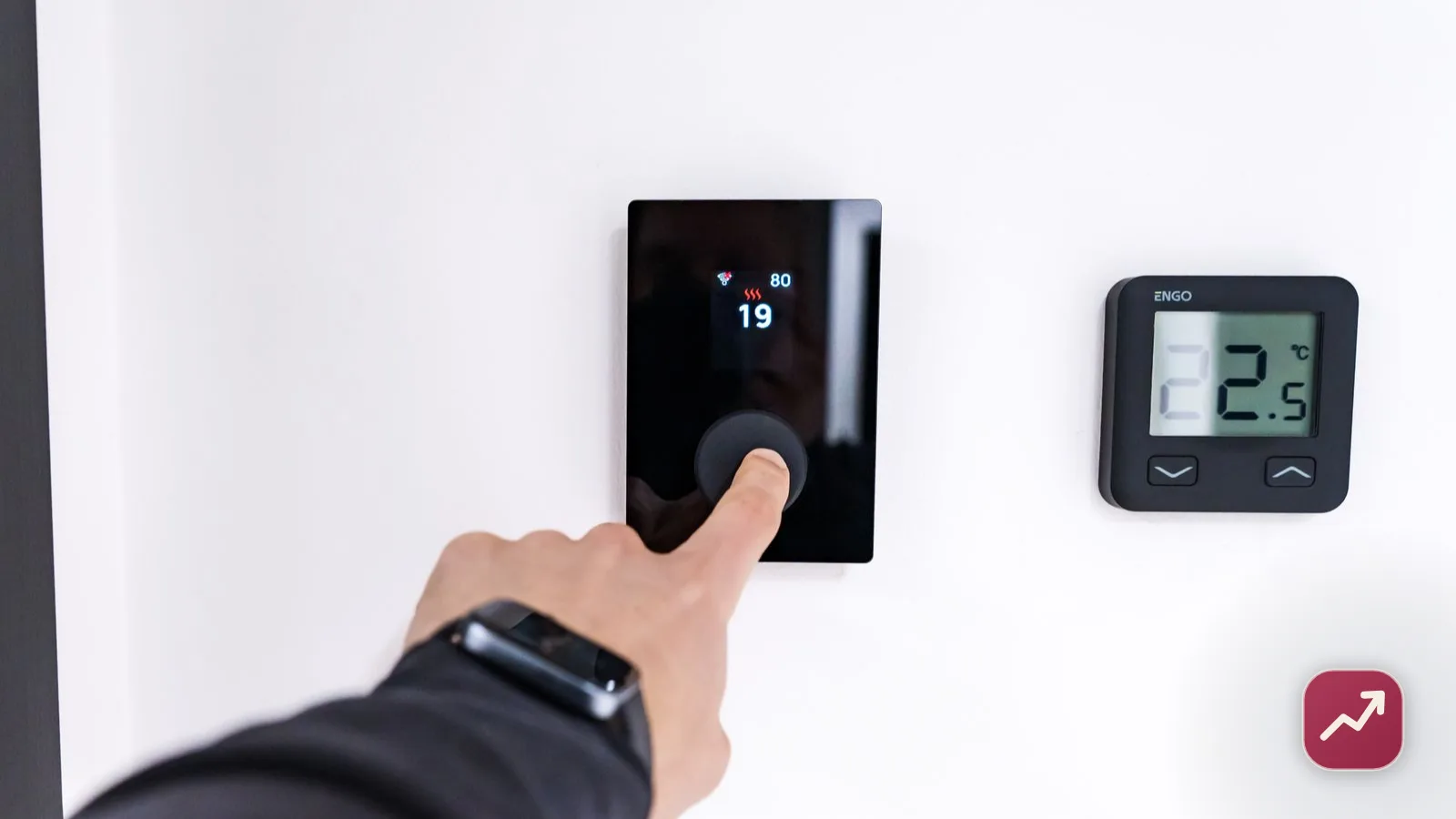
The federal residential energy survey puts air conditioning at about a fifth of household electricity, space heating and water heating at roughly an eighth each, and lighting at around six percent — a useful corrective to the idea that lamps are the problem. The practical consequences are dull and effective. Every degree you lower the thermostat in winter cuts heating energy by a noticeable margin, and heating a home to around 19 to 20 degrees Celsius, or 66 to 68 Fahrenheit, is the standard public-health recommendation rather than an austerity measure. Washing laundry cold, drying it on a rack when you can, and turning the water heater down to roughly 49 degrees Celsius or 120 Fahrenheit are the three changes with the best ratio of saving to inconvenience. And if your home heats with electric resistance — baseboards, or a furnace with strip heat, still the case in something like 25 million American homes — then replacing that with a heat pump is the largest single saving available to you, which is why it belongs in the next section rather than this one.
- Heating and cooling — usually the single largest share of a home’s electricity use.
- Water heating — second place in most homes, and easy to turn down.
- Tumble dryer — the most expensive appliance most people use daily without thinking.
- Standby power — real, but small; fix it last, not first.
Cheap fixes, expensive fixes and what actually pays back#
Efficiency spending falls into two very different categories, and mixing them up is how people end up disappointed. The cheap tier — draught-proofing a door, insulating hot-water pipes, switching remaining bulbs to LED, fitting a timer or a smart thermostat — costs tens or low hundreds and usually pays for itself within a season or two. The expensive tier — new windows, a heat pump, wall insulation, solar panels — costs thousands and pays back over years, which can still be an excellent decision but is a capital project rather than a bill-saving trick.
One thing changed recently and is catching people out: the federal tax credits that covered 30 percent of residential solar and a share of insulation, windows and heat pumps were ended early by legislation signed in July 2025, and no longer apply to property placed in service after the end of 2025. Paying for the work in advance does not rescue them. State, utility and local incentives still exist, and that is now where the money is, so check those before you price a project. Judge the expensive tier the way you would judge any investment: what does it cost, what does it save per year, and how long until it has paid for itself. If the answer is longer than you expect to live in the property, the calculation changes entirely. And before committing savings to a heat pump, make sure the money you would be spending is not the money you need for something breaking, which is exactly what an emergency fund exists to cover.
Help with your electricity bill if you cannot pay#
This is the section most people skip and should not. In the United States the main federal programme is LIHEAP, the Low Income Home Energy Assistance Program, which is funded federally and administered state by state — you apply through your state or tribal agency, not through Washington, and both heating and cooling assistance exist depending on where you live. The striking part is how little of it gets claimed: on the most recent published count, only about one income-eligible household in eight actually received heating help. A separate federal programme funds weatherisation work on low-income homes, which cuts the bill permanently rather than paying it once. The federal government keeps a plain-language guide to energy bill help, and both the national energy assistance referral line and the 2-1-1 service will route you to the right local office.
Two other tools are worth asking your utility about directly. Budget billing, sometimes called levelised billing, averages your annual cost into twelve equal payments, which does not save money but makes a seasonal bill survivable. And most states impose shutoff protections — periods, usually in extreme cold or heat, during which a utility may not disconnect a residential customer — but these are state rules, not federal ones, and the coverage is patchier than people assume: most jurisdictions protect against cold, fewer than half against heat, and a handful have no seasonal protection at all. A moratorium also postpones the disconnection rather than cancelling the debt, and it frequently does not bind municipal utilities or co-ops. There were more than 13 million residential disconnections in the United States in 2024, so this is not a theoretical risk. If you are behind, call before the disconnection notice rather than after; payment plans are far easier to negotiate while the account is still live.
Switching supplier without getting burned#
Competitive retail energy markets attract two kinds of sales pressure. The first is the doorstep or phone offer with a teaser rate that converts to something far worse after a few months, sometimes with an early-exit fee attached. The second is outright fraud: someone claiming to be from your utility, insisting your power will be cut off within the hour, and demanding immediate payment by gift card, wire or app transfer. No utility operates that way, and the demand for an unusual payment method is the tell.
Protect yourself with three habits. Never agree to switch on the doorstep or the phone — take the offer in writing and compare it at home against your current price per kWh including every fee. Check the contract length and the exit penalty before the rate. And if someone calls about disconnection, hang up and dial the number printed on your actual bill. Our guide on how to avoid financial scams covers the wider pattern, which is always urgency plus an unusual payment channel, and the Federal Trade Commission keeps a short page on utility imposter scams worth reading once. Canada went further than warnings: Ontario banned door-to-door energy contract selling outright at the start of 2017, and a contract signed on the doorstep there is simply void.
If you rent, this is what you can still change#
Tenants tend to assume the electricity bill is fixed by the building. Often it is not. If the account is in your name, the rate plan is yours to change even though the property is not, and that single decision is usually worth more than any behavioural change available to you. Portable measures travel with you too: draught excluders, thermal curtains, LED bulbs, a smart plug on the water heater, and a dryer you simply use less.
What you cannot do is insulate someone else’s walls or replace their boiler. What you can do is document a genuinely inefficient property, because in several countries energy performance is now a legal characteristic of a rented home rather than a matter of taste, and single-glazed windows with electric convector heaters are a rent negotiation point. Before signing anything, ask for the last twelve months of bills — a landlord who refuses is telling you something. Our guide on how to rent an apartment covers what else to check before you commit.
How the electricity bill works in Spain, France, Russia and Canada#
The instinct to shop around is a very Anglo-American reflex, and it does not travel cleanly. In Spain households choose between a regulated tariff whose hourly price follows the wholesale market and the free market, where suppliers sell fixed-price deals; the regulated side also has a lower rate at night and at weekends, and the contracted power level in kilowatts is a fixed cost most households have set too high and never revisited. Spain also runs a means-tested social discount that only exists on the regulated tariff.
In France a regulated tariff still exists for households and is the reference everyone else prices against, the off-peak system of heures creuses gives eight cheap hours a day, and a means-tested energy voucher helps lower-income households pay. Russia works differently again: tariffs are set regionally and revised on a fixed annual schedule rather than negotiated, there is no supplier to switch to, and the lever available to households is the meter type and a means-tested subsidy for those spending too much of their income on utilities. Canada is provincial: Ontario lets households pick time-of-use, tiered or an ultra-low overnight plan whose overnight rate is about a tenth of its weekday evening peak, and it resets those prices once a year on 1 November; Quebec has some of the cheapest power on the continent, which is why households there burn roughly two and a half times the kilowatt-hours of an Alberta home and still land on a similar bill; and in Alberta anyone who does not choose a retailer falls onto a regulated Rate of Last Resort, which replaced the older regulated rate option at the start of 2025.
The bottom line#
Work in order of size. Check what rate you are on and what the alternatives cost, because that is the largest lever and it takes an afternoon. Then find out whether you qualify for public help, since the application costs nothing and the money is already budgeted. Then move your heavy loads to cheap hours if your tariff has them. Only then start worrying about standby lights.
One honest caveat: prices in every country covered here are set by energy markets and regulators, not by your diligence, and a cold winter will beat a careful household. That argues for treating energy as a variable cost you plan for rather than one you expect to eliminate — the same discipline described in our 50/30/20 budget under pressure piece, and part of the broader question of protecting your money from inflation. Lower the bill where you genuinely can, then stop paying the emotional tax on the part you cannot.
Frequently asked questions
Frequently asked questions
Check your rate plan before you change any habits. Comparing your current price per kilowatt-hour against the default or regulated tariff, and against fixed offers, takes about an hour and frequently saves more than a year of switching lights off. After that, the second fastest win is checking whether you qualify for a social tariff or public assistance, and the third is moving the washing machine, dishwasher and any car charging into cheap off-peak hours if your tariff offers them.
Educational content — not personalised financial advice.
Read next

How to Make a Budget That Actually Works
How to make a budget that actually works: start from your real take-home pay (after tax, FICA and deductions), track where your money goes for a month, choose a method like 50/30/20 or zero-based, split spending into needs, wants and goals, automate your savings, use sinking funds for irregular bills, fit debt payments in, pick a tool, and review monthly.
The 50/30/20 Budget, Stress-Tested for a High-Cost Year
The 50/30/20 rule assumes needs fit in half your paycheck. In an expensive year they rarely do. Here is where the template breaks and how to rebuild it honestly.

Moving Abroad: What Happens to Your Taxes, Accounts and Pension
What happens to your money when you move abroad: how tax residence actually works, why US citizens keep filing wherever they live, the exclusion and the credit that prevent double taxation, states that keep taxing former residents, FBAR and Form 8938 reporting, what happens to a 401k or IRA, pensions and health cover across borders, and how leaving works in Canada, Spain, France and Russia.